
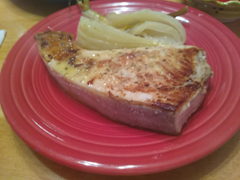
 The traditional Salmoriglio sauce of Sicily is a perfect accompaniment to swordfish and other full-flavored fishes served hot off the grill. It's easy to make and it works on swordfish steaks and kebabs.
It works as a marinade, too, but I think that's too much for fish; I'd save that for pork or chicken.
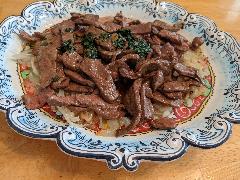 It took an awfully long time for me to find a recipe for a calve's liver dish that I liked. As was the case with many of us, my mom made it from time to time, a big slab of strange-looking, strange-smelling, strangely-textured strangeness that nobody wanted to eat. But this one I liked a lot, and I and my friend Andy both took additional helpings.
 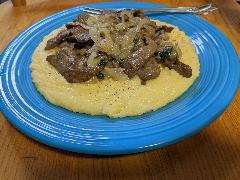 I decided a long time ago that I did not trust liver from cattle raised on factory farms fed who knows what feed and drugs, because all of that ultimately is processed by the liver. I found some Caldwell Farms calf liver at the Belfast Coop in Belfast, Maine. I knew it was going to be as good a piece of liver as I am likely to find, so I bought it for this recipe.
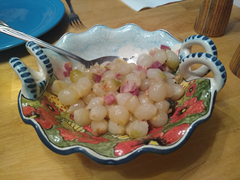 This is another fine, simple Italian recipe using pearl onions. Supermarket frozen onions work fine in this recipe, and they save a ton of time and sore thumbs from peeling.
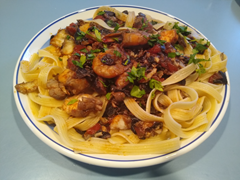 In the United States, Marinara sauce has come to mean a simple, vegetarian tomato sauce, but it isn't that way in Italy. Marinara means "in the mariner's style", which emphasizes thrift and availability of local, inexpensive ingredients, sometimes but not aways including some sort of seafood that might have been by-catch.
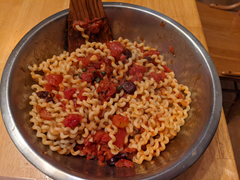 This feisty pasta dish is named for the fiery protagonist of Cavalleria Rusticana, an opera by Pietro Mascagni (who scored this timeless hit in a competition as a young man, and then never had another hit).
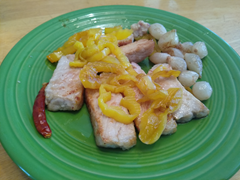 This punchy little lunch dish goes great with some crusty bread!
 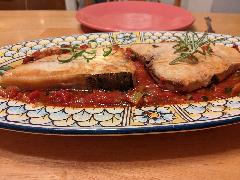 Here is a presentation somewhat more restrained than the
 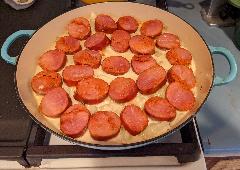 This is a hearty winter dish, bursting with flavor and calories! I think this would be good after shoveling snow for an hour. It's quite easy, you just boil potatoes and then simmer them in cream and top with cooked andouille sausage. The andouille is spicy (especially if you use an American Cajun variety), but the cream and the potatoes moderate the punchiness to a fine degree; this is easy to gobble down more than you should.
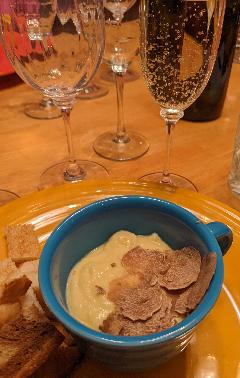 The Fonduta Valdostana is the Italian form of the French/Swiss Fondue, popular in the Valle d'Aosta on the southern slopes of the French Alps. The key differences are:
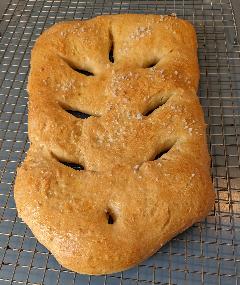 A fougasse is a French focaccia, often cut into elaborate shapes for more crusty surface area. If you are in the area of Kittery, Maine, you can find excellent full and half-size fougasse at
 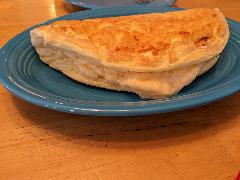 This has been called the most expensive omelette in the world, which it may be at 35 Euros if you get it at its
 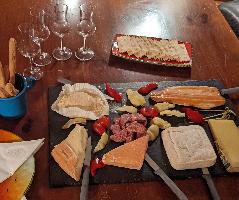 On 5 December 2021, our friends Dave and Lisa joined us for a grand discovery feast exploring the cuisine of Italy's far northwestern corner. To make it extra-special, they generously sprang for two fresh white truffles from Alba, which are in season in early winter, local to the Piedmont region, and terribly expensive!
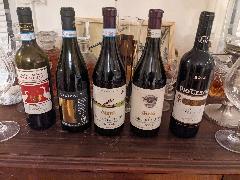 Piemonte and Valle d'Aosta are the foothills to the Alps, and they border France to the west and Switzerland to the north. Valle d'Aosta is all mountainous and heavily influenced by Swiss and French Alpine cuisine; Piemonte is the piedmont region that slopes from the mountains down to Liguria and the coast west of Genoa, known for its excellent wines and expensive white truffles. Both feature mushrooms, cheese, polenta, chestnuts, freshwater fish, and other ingredients used in making this feast. This grand Italian feast included no pasta and no tomatoes!
 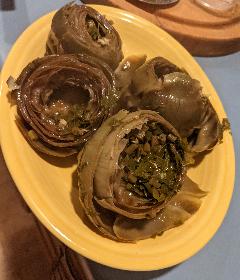 I first enjoyed herb-stuffed Roman artichokes in Rome, where they were naturally well-prepared. It was a delicious dish that I vowed to reproduce one day, not knowing that there's a lot to learn about preparing artichokes.
 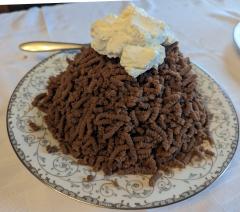 This is a wonderful and comparatively simple dessert from the mountains of northern Italy, but it requires a food mill to get the proper texture and look. I made this one for a feast that focused specifically on Italy's Piedmont and Valle d'Aosta regions. The city of Val d'Aosta and the region are at the foot of that famous Alpine mountain on the border between Italy and Switzerland. It is traditionally topped with whipped cream to resemble the snow-capped mountain. In the photo it is surrounded by Marrons Glace and foil-wrapped gianduia (chocolate hazelnut candies) from Torino.
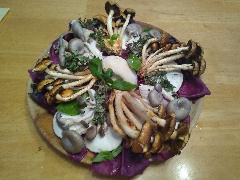 You can make quite a pretty salad if you have access to good mushrooms, which is getting easier in New England now that several farms have started in Maine. This one includes Chestnut Mushrooms, Lion's Mane, Blue Oyster, and Button Mushrooms, dressed with olive oil and lemon juice with sea salt, fresh basil, and parsley.