
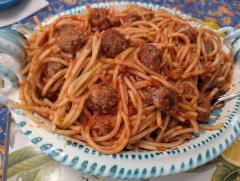
 This version of spaghetti and meatballs comes from Abbruzzo but it is eaten all over Italy. Spaghetti alla Chitarra (say key-TAH-rra) is a long pasta that is traditionally made fresh, then rolled into sheets as thick as uncooked spaghetti and pressed onto a chitarra, a frame with many long closely-spaced parallel wires. The resulting spaghetti is square in cross section. The square chitarra pasta has more surface area than round spaghetti so it holds more sauce.
Spaghetti alla chitarra is served many ways, but one of the most traditional ways is with a simple tomato sauce and tiny meatballs called pallottine.
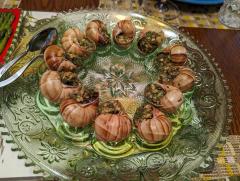 This is like
 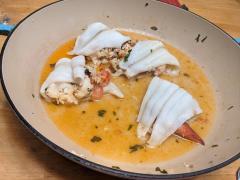 This one is for a special occasion! You make a simple stuffing of mostly crab meat, fold fillets of sole over the filling, and poach. When it's done you reduce the cooking liquid and enrich it with lobster stock and butter.
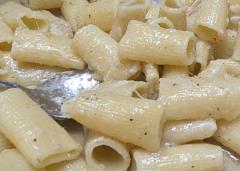 Cacio e Pepe (say KAHT-cho ay PEP-ay) is a traditional Roman dish of local pasta dressed with a wonderfully cheesy sauce that, like
 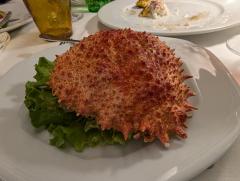 In May and June of 2024, we explored Prague, Vienna, Salzburg, Venice, Sorrento, and all the parts of Italy that we had not yet explored, except Sardinia. It was the biggest and final of three grand vacations that I had been planning since 2020.
 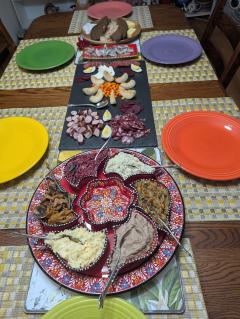 It started with a chance comment from my friend Bryan that his knowledge of food in the Slavic countries north of the Middle East was limited, and that as far as he knew the people of Russia silently starved. I was in the room, and our friend John Morse was there as well. As I prepared a reply, John quickly said that there a lot of really interesting Russian food and that Bryan and his wife should have a Russian feast at my house!
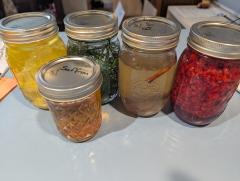 It took a few weeks, but we finally did it last night, 17 November 2024. Guests were Bryan Gregory and his wife Bridget, and our friends Don Nicholson and his wife Jen. Don and I have known each other for 25 years, but this was his first feast at our house.
 This golden oldie was invented in the 1890s by the early master Harry Johnson, and freshened up a century later by modern cocktail engineer and historian Dale DeGroff. It's on the sweet side but nicely balanced by the generous dose of orange bitters.
 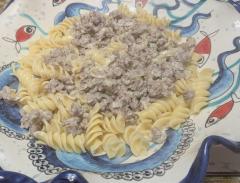 This is a delicious sauce made with cream and pork sausage. The town of Norcia in mountainous southeastern Umbria is renowned for its pork products, and it is the source of this simple and delicious recipe. The town is Norcia, and the sauce made in the style of Norcia uses the adjectival form Norcina, with the extra "n".
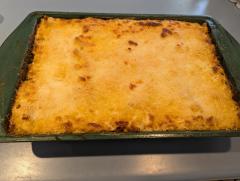 Lasagna is a wonderful Italian dish, an opportunity for all sorts of creativity, but there are two especially classic lasagna recipes that you should know about: this Lasagna alla Bolognese, and the Lasagna Napoletana. The Neapolitan version includes sausage and meatballs, fresh mozzarella and ricotta, it's quite a complex production! The Bolognese version is far simpler, just lasagna noodles,
 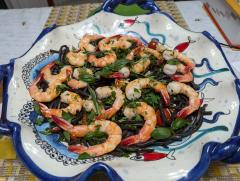 This is a primo version of the classic Trieste dish Scampi alla Busara, but the traditional scampi (langoustines) are hard to come by in New England, and when made with shrimp it's a great pasta-topper!
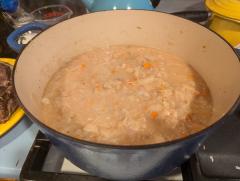 Despite its name proclaiming a Genoese origin, this delicious Neapolitan pasta sauce, a cousin of the French soubise onion sauce, is unknown in Genoa today. It is thought to have been brought to Naples by sailors from Genoa long ago, and to have survived in the south long after it faded into obscurity in the north.
 This is not a vegetarian recipe. A beef roast cooks with the onions, flavoring them, but it is not served in the sauce or with the pasta at all. In Italy it's traditional to have a simple pasta course before a main course, the primo before the larger secondo. At a fine dinner, you would expect a small dish of pasta with one of the many wonderful sauces (ragu, sugo, salsa) invented for the purpose. A heaping plate of spaghetti is what you eat when you can't afford the secondo course.
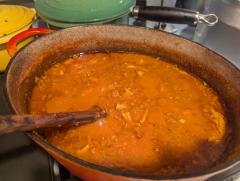 This is the classic Italian meat sauce, with an official recipe approved by the Accademia Italiana della Cucina and recorded with the Bologna Chamber of Commerce. The recipe gets updated every few generations to account for the changing availability of ingredients, and importantly, to note which popular variations that have arisen are incompatible with the Accademia's focus on authenticity and quality (for example, using cream instead of milk, or brandy instead of dry wine).
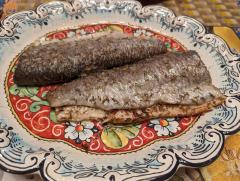 This French trout dish is easy to prepare and you can have it on the table in half an hour. Besides the fish, it uses only 5 ingredients that you probably have in the house already, so it's a good recipe to know if you're sometimes lucky enough to get fresh trout!
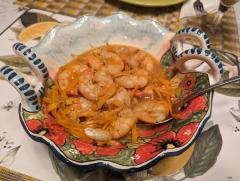 Here's another unexpected and delicious flavor combination from Italy, somewhat Americanized. The original Italian recipe, gamberoni all'arancia in padella, used olive oil instead of butter, used bigger shrimp, it skipped the brief marination step, and it did not include the orange zest. I tried it that way first, but then I did it this way and we both liked it better. I think the shredded orange zest makes it more pretty, too.
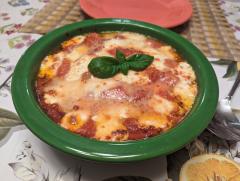 This is a staple of children's menus but it's also a delightful primo course when made with good ingredients and fresh gnocchi, and it's vegetarian, too! Kids like it because it has no garlic or onion, but top-quality ingredients really shine, like bright sunny Sorrento in the summer!