
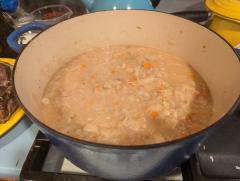
 Despite its name proclaiming a Genoese origin, this delicious Neapolitan pasta sauce, a cousin of the French soubise onion sauce, is unknown in Genoa today. It is thought to have been brought to Naples by sailors from Genoa long ago, and to have survived in the south long after it faded into obscurity in the north.
Now Sugo alla Genovese borders on a religion in Naples, where countless households make it every Sunday with the traditional local dried pasta from Gragnano, bought long and broken into serving-size lengths just before boiling it, a job often performed with help from the children of the household. The sauce cooks all day, and when it's done the onions are sweet and amazing.
 This is not a vegetarian recipe. A beef roast cooks with the onions, flavoring them, but it is not served in the sauce or with the pasta at all. In Italy it's traditional to have a simple pasta course before a main course, the primo before the larger secondo. At a fine dinner, you would expect a small dish of pasta with one of the many wonderful sauces (ragu, sugo, salsa) invented for the purpose. A heaping plate of spaghetti is what you eat when you can't afford the secondo course.
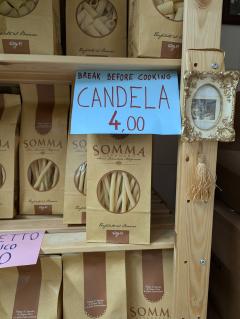
The photo to the right is from an artisan pasta shop in Gragnano. Candela is a long tube-like pasta shape about twice as wide as bucatini. As you can see in the photo, Mr. Somma wants tourists to know that this particular shape is to be broken into shorter lengths for cooking. It's in English because the Italians already know this.
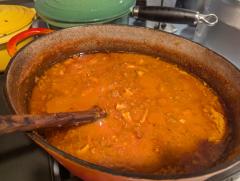 This is the classic Italian meat sauce, with an official recipe approved by the Accademia Italiana della Cucina and recorded with the Bologna Chamber of Commerce. The recipe gets updated every few generations to account for the changing availability of ingredients, and importantly, to note which popular variations that have arisen are incompatible with the Accademia's focus on authenticity and quality (for example, using cream instead of milk, or brandy instead of dry wine).
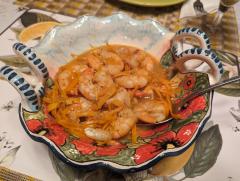 Here's another unexpected and delicious flavor combination from Italy, somewhat Americanized. The original Italian recipe, gamberoni all'arancia in padella, used olive oil instead of butter, used bigger shrimp, it skipped the brief marination step, and it did not include the orange zest. I tried it that way first, but then I did it this way and we both liked it better. I think the shredded orange zest makes it more pretty, too.
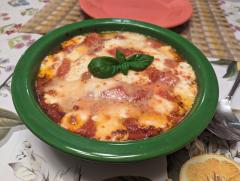 This is a staple of children's menus but it's also a delightful primo course when made with good ingredients and fresh gnocchi, and it's vegetarian, too! Kids like it because it has no garlic or onion, but top-quality ingredients really shine, like bright sunny Sorrento in the summer!
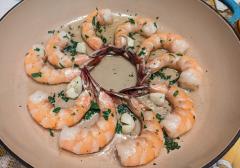 This recipe for gamberoni al forno (baked jumbo shrimp) is simple and easily expandable. It has just four ingredients, three of which you probably have in the kitchen most days.
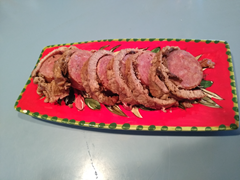 Cotechino in Camicia means "Cotechino in a shirt" because in this recipe the unctuous cotechino sausage is wrapped in a shirt of lean chicken!
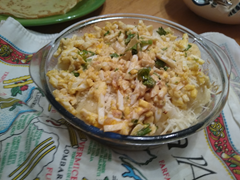 Camillo Benso, the Count of Cavour was a hugely important 19th century Sardinian and Piedmontese politician and patriot who also is known for his favorite dishes of traditional Piedmontese cuisine. Like many Piedmontese dishes, this one uses butter where recipes from more southerly states would use olive oil, and it uses the Grana Padano cheese of Piemonte and Lombardia where other dishes would use Parmigiano-Reggiano.
 Here's one way to use the black kale that comes in your CSA share. It's a simple recipe that's good with sausages.
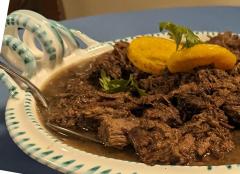 The Brasato al Barolo is a rightly celebrated main dish of Italy's Piedmont region, traditionally made using the local Barolo wine. That can become very expensive in this country, but driving through the Piedmont I was astonished to see €10 bottles of Barolo on endcap displays in highway rest areas! The best Barolos can fetch
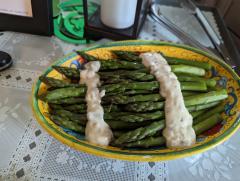 I was surprised when I first saw this. It's so simple, with no hard-to-get ingredients, that I would expect to see it on menus and at picnics and other al fresco dining opportunities. It seemed at first counterintuitive, but Tartar Sauce used to be used for many things beside fried fish, and this is just one simple example.